A History of
Information Technology and Systems: Part Two
- Four basic periods
Characterized by a principal technology used to solve the input, processing,
output and communication problems of the time:
- Premechanical,
- Mechanical,
- Electromechanical, and
- Electronic
D. The Electronic
Age: 1940 - Present.
- First Tries.
- Early 1940s
- Electronic vacuum tubes.
- Eckert and Mauchly.
- The First High-Speed, General-Purpose Computer Using Vacuum Tubes:
Electronic Numerical Integrator and Computer (ENIAC)
The ENIAC team (Feb 14, 1946). Left to right: J. Presper Eckert, Jr.;
John Grist Brainerd; Sam Feltman; Herman H. Goldstine; John W. Mauchly;
Harold Pender; Major General G. L. Barnes; Colonel Paul N. Gillon.

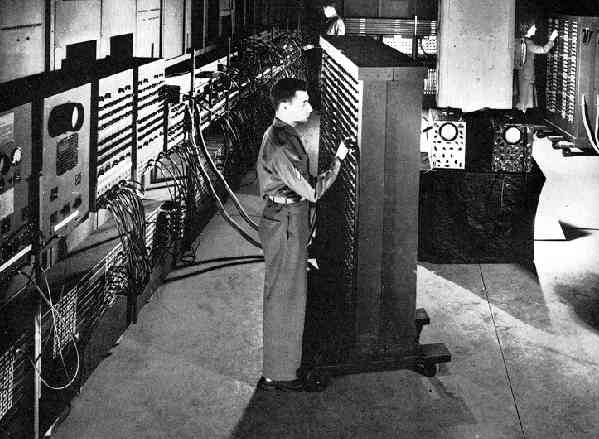
Rear view (note vacuum tubes).

- Electronic Numerical Integrator and Computer (ENIAC)
- 1946.
- Used vacuum tubes (not mechanical devices) to do its calculations.
- Hence, first electronic computer.
- Developers John Mauchly, a physicist, and J. Prosper Eckert,
an electrical engineer
- The Moore School of Electrical Engineering at the University
of Pennsylvania
- Funded by the U.S. Army.
- But it could not store its programs (its set of instructions)
- The First Stored-Program Computer(s)
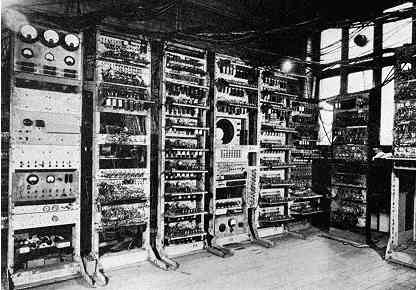
The Manchester University Mark I (prototype).
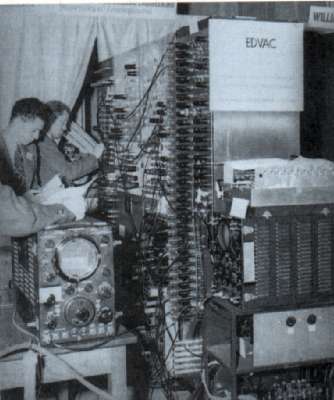
- Early 1940s, Mauchly and Eckert began to design the EDVAC -
the Electronic Discreet Variable Computer.
- John von Neumann's influential report in June 1945:
- "The Report on the EDVAC"
- British scientists used this report and outpaced the Americans.
- Max Newman headed up the effort at Manchester University
- Where the Manchester Mark I went into operation
in June 1948--becoming the first stored-program computer.
- Maurice Wilkes, a British scientist at Cambridge University,
completed the EDSAC (Electronic Delay Storage Automatic Calculator)
in 1949--two years before EDVAC was finished.
- Thus, EDSAC became the first stored-program computer in
general use (i.e., not a prototype).
- The First General-Purpose Computer for Commercial Use: Universal
Automatic Computer (UNIVAC).
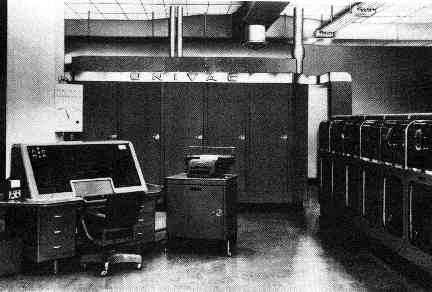
UNIVAC publicity photo.
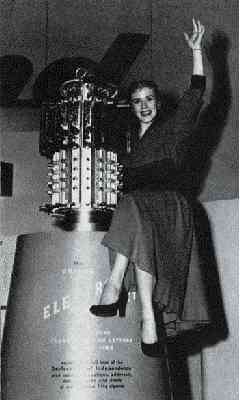
- Late 1940s, Eckert and Mauchly began the development of a computer
called UNIVAC (Universal Automatic Computer)
- Remington Rand.
- First UNIVAC delivered to Census Bureau in 1951.
- But, a machine called LEO (Lyons Electronic Office) went
into action a few months before UNIVAC and became the world's first
commercial computer.
- The Four Generations of Digital Computing.
- The First Generation (1951-1958).
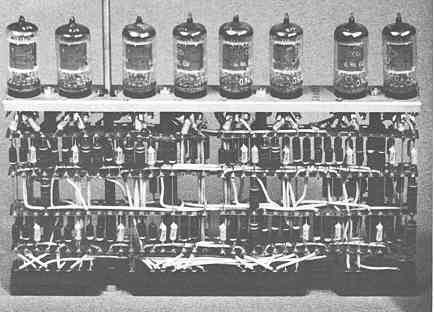
- Vacuum tubes as their main logic elements.
- Punch cards to input and externally store data.
- Rotating magnetic drums for internal storage of data and
programs
- Programs written in
- Machine language
- Assembly language
- The Second Generation (1959-1963).
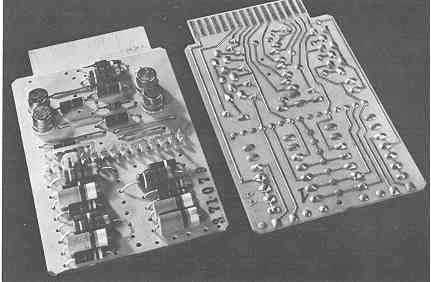
- Vacuum tubes replaced by transistors as main logic element.
- AT&T's Bell Laboratories, in the 1940s
- Crystalline mineral materials called semiconductors
could be used in the design of a device called a transistor
- Magnetic tape and disks began to replace punched cards as external
storage devices.
- Magnetic cores (very small donut-shaped magnets that could be polarized
in one of two directions to represent data) strung on wire within
the computer became the primary internal storage technology.
- High-level programming languages
- The Third Generation (1964-1979).
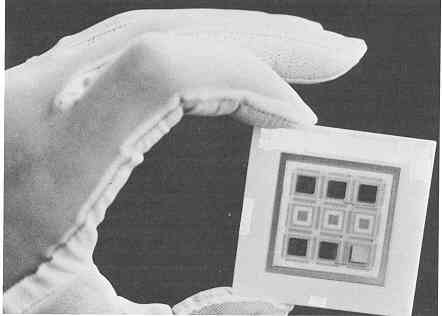
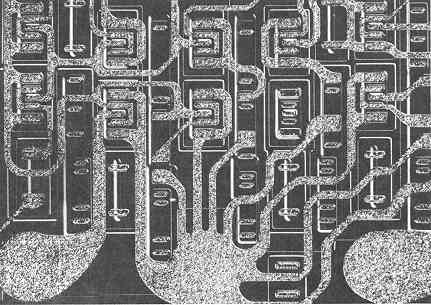
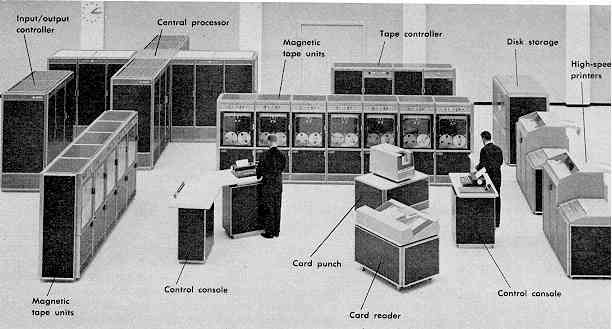
- Individual transistors were replaced by integrated circuits.
- Magnetic tape and disks completely replace punch cards as
external storage devices.
- Magnetic core internal memories began to give way to a new
form, metal oxide semiconductor (MOS) memory, which, like integrated
circuits, used silicon-backed chips.
- Operating systems
- Advanced programming languages like BASIC developed.
- Which is where Bill Gates and Microsoft got their start
in 1975.
- The Fourth Generation (1979- Present).
- Large-scale and very large-scale integrated circuits (LSIs and
VLSICs)
- Microprocessors that contained memory, logic, and control circuits
(an entire CPU = Central Processing Unit) on a single chip.
- Which allowed for home-use personal computers or PCs,
like the Apple (II and Mac) and IBM PC.
- Apple II released to public in 1977, by Stephen Wozniak
and Steven Jobs.
- Initially sold for $1,195 (without a monitor); had
16k RAM.
- First Apple Mac released in 1984.
- IBM PC introduced in 1981.
- Debuts with MS-DOS (Microsoft Disk Operating System)
- Fourth generation language software products
- E.g., Visicalc, Lotus 1-2-3, dBase, Microsoft Word, and
many others.
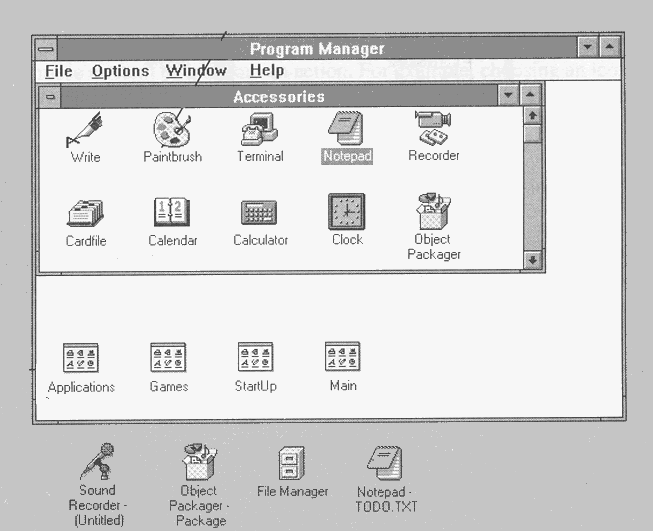
- Graphical User Interfaces (GUI) for PCs arrive in
early 1980s
- MS Windows debuts in 1983, but is quite a clunker.
- Windows wouldn't take off until version 3 was released
in 1990
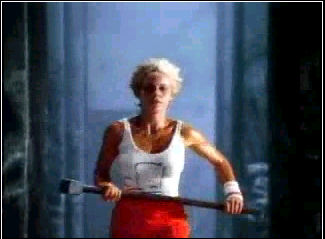
- Apple's GUI (on the first Mac) debuts in 1984,
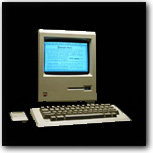
with a one-time only Super
Bowl ad.
Bibliography
- Kenneth C. Laudon, Carol Guercio Traver, Jane P. Laudon, Information
Technology and Systems, Cambridge, MA: Course Technology, 1996.
- Stan Augarten, BIT By BIT: An Illustrated History of Computers (New
York: Ticknor & Fields, 1984).
- R. Moreau, The Computer Comes of Age: The People, the Hardware, and
the Software, translated by J. Howlett (Cambridge: MIT Press, 1984).
- Telephone History Web Site. http://www.cybercomm.net/~chuck/phones.html
- Microsoft Museum. http://www.microsoft.com/mscorp/museum/home.asp
- Philip B. Meggs, A History of Graphic Design, 2nd ed., New York:
Van Nostrand Reinhold, 1992.
Last revised: May 25, 2000 11:13 AM
Comments: jbutler@ua.edu